

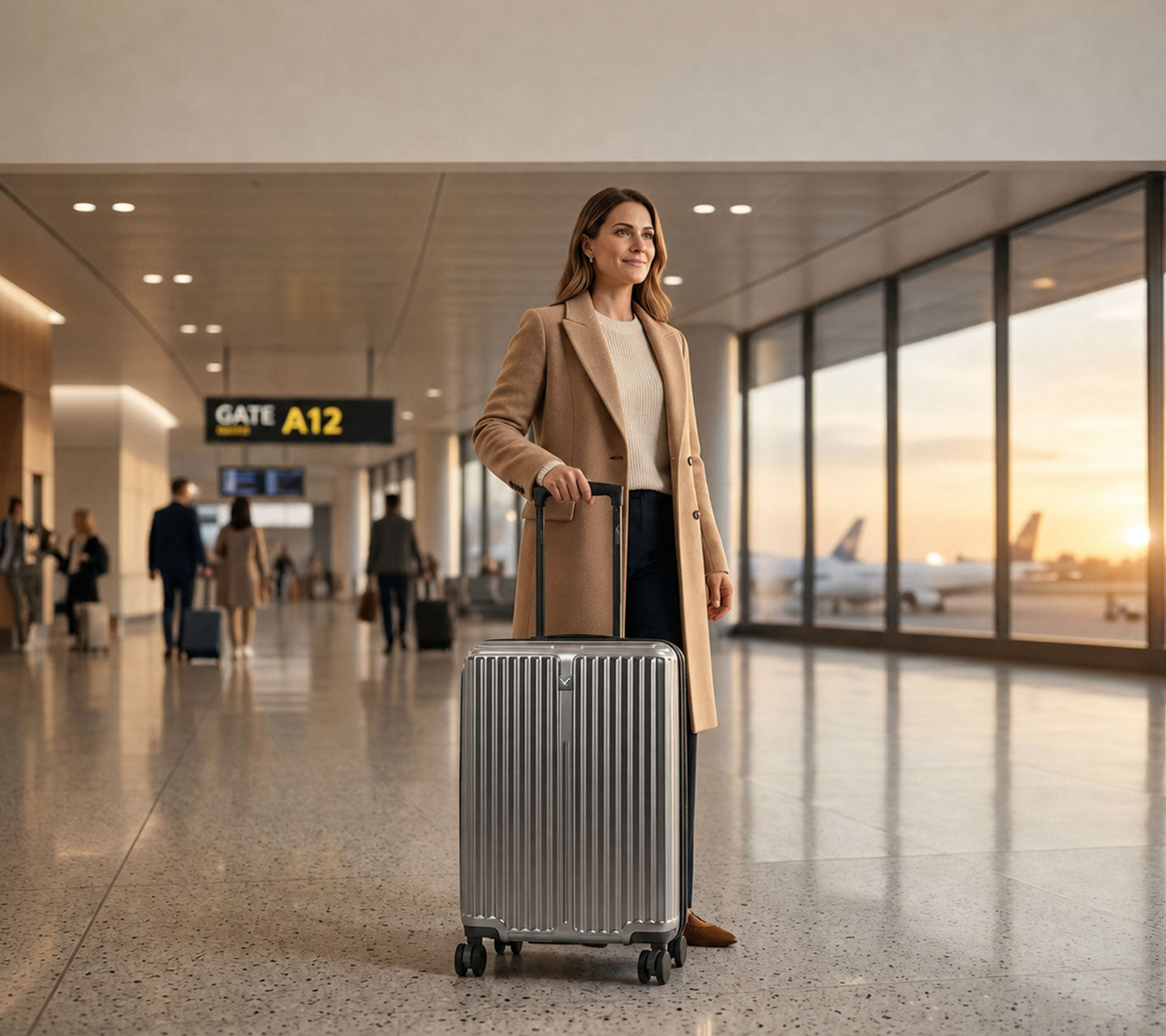
Whether you’re a seasoned packer or still googling “what can I take on a plane” the night before your flight, cabin baggage rules have a habit of creating issues at the gate. Allowances vary by airline; bag sizes differ and what counts as a personal item seems to depend entirely on who’s working at the airline that day.
This article covers everything you need to know: standard size and weight limits, what you can and can’t bring through security, how the rules differ between airlines and how to pick a bag that works across the board. If you don’t have luggage yet, browse our cabin suitcases, cabin bags or underseat luggage to make sure you bring the right size onboard.
Last updated: April 2026. Rules change frequently -- always check your airline's official website before travelling.
What Is Cabin Baggage?
Cabin baggage (also called hand luggage or carry-on luggage) is any bag you take into the aircraft cabin with you rather than checking it into the hold. You stow it in the overhead locker or under the seat in front.
Most airlines allow one main cabin bag plus one smaller personal item, such as a handbag, laptop bag or small backpack. That smaller bag should be able to fit in the area under the seat in front of you. Some budget carriers only allow this personal item in the cabin for free and charge extra for anything going in the overhead locker.
Standard Cabin Bag Size Limits

There is no single universal size limit, which is the source of a great deal of airport-related stress. That said, most carriers cluster around similar dimensions.
The most widely accepted maximum size is 55 x 40 x 20 cm (including handles and wheels). Some airlines stretch this slightly; others go even smaller. Budget carriers usually apply stricter limits depending on your fare type.
Worth knowing in 2026: enforcement has tightened across busy UK routes, with more airlines using automated bag scanners and gate sizers to check compliance before boarding.
If your bag is borderline, it is no longer a gamble worth taking. Size limits vary significantly between carriers; for a full airline-by-airline breakdown, see our cabin luggage size guide for UK airlines.
Weight Limits for Carry-On Luggage
Many airlines don’t enforce a specific cabin bag weight limit, but that doesn’t mean there isn’t one. The ones that do check tend to fall between 7 and 10 kg. Emirates and some long-haul carriers lean towards the lower end; European airlines tend to be more lenient. Budget carriers are more likely to weigh bags at the gate, particularly on busier routes. If your bag is over the limit, you’ll be paying to check it in - and that’s a tough hit to the holiday budget before boarding!
Remember, a bag that’s genuinely heavy is also a bag you’ll be lugging through the terminal. Our soft shell cabin suitcases are a good place to start if weight is a concern - soft shell constructions tend to come in lighter than hard shell equivalents at comparable sizes.
Personal Item Rules: What Counts as a Personal Item?
Most airlines allow a second, smaller item in addition to your main cabin bag. What qualifies varies, but it’s generally a bag that fits under the seat in front of you. Typical dimensions for a personal item are around 40 x 30 x 15 cm, though again; this depends on the airline. Handbags, laptop bags and small backpacks usually pass without issue. A large backpack stuffed to capacity probably won’t.
The key distinction with budget carriers is that your personal item may be all you’re entitled to without paying extra. Ryanair, for example, includes a small personal item (40 x 20 x 25 cm) in every fare but treats the overhead locker bag as a paid add-on. If you want a bag that genuinely fits under the seat without any guesswork, our underseat luggage is designed with those dimensions in mind.
What You Can and Can not Take in Cabin Baggage

Security rules in the UK and EU are set centrally rather than by individual airlines. Here’s what you need to know.
Liquids, Aerosols and Gels
The 100 ml rule is still very much in force on most routes. Each container must hold no more than 100 ml and they must all fit into a single transparent, resealable bag no larger than 20 x 20 cm - roughly a one-litre bag.
A few airports now have CT scanning technology that removes the need to take liquids out of your bag, but this isn’t universal. Until it is, assume the 100 ml rule applies.
There are exceptions worth knowing about:
There are exceptions worth knowing about:
- Baby milk and baby food (enough for the journey)
- Prescription medicines (with documentation if possible)
- Liquids bought airside, in sealed tamper-evident bags
Electrical Items and Batteries
Laptops, tablets and phones are all fine in the cabin. In fact, lithium batteries above a certain capacity are generally required to travel in the cabin rather than the hold.
Large power banks (over 160 Wh) are usually prohibited entirely. Standard personal power banks (most are under 100 Wh) are permitted in the cabin but not the hold.
Sharp Items and Prohibited Goods
Knives, scissors with blades longer than 6 cm, razor blades and similar items are not permitted in the cabin. They can go in your hold luggage.
Other prohibited items include firearms and replica weapons, flammable substances and anything that could be used as a weapon.
It is also worth knowing that protein powders and nutritional supplements in large quantities can trigger manual security checks, as scanners struggle to read through dense powders. Pack them in checked luggage or use travel-sized sealed sachets to avoid delays at the security tray.
The full prohibited items list is available on the Civil Aviation Authority website.
Food
Solid food is generally fine to bring through security in your hand luggage. That includes fruit, sandwiches, snacks, even a packed lunch. Soups, sauces and similar liquids fall under the 100 ml rule. Airport food can be expensive, so it may be a good idea to bring your own meal.
How Cabin Baggage Rules Differ Between Airlines
For passengers flying on a single airline, the rules are usually clear. The situation gets trickier when you are connecting between two carriers or booking through a travel agent who bundles different airlines.
The general principle is that each airline applies its own rules for its own segment. So, if you fly Ryanair to a hub and then connect onward with British Airways, both sets of rules apply for the entire journey. In practice this means packing to the stricter of the two allowances from the start. Ryanair's free underseat bag is 40 x 30 x 20 cm; British Airways allows a much larger 56 x 45 x 25 cm cabin bag. If you pack to the BA limit and your first leg is Ryanair, you will face a gate fee before you have even reached your connection.
The same logic applies to weight limits. If one carrier allows 10 kg and the other has no stated limit, treat 10 kg as your ceiling for the whole trip.
It is also worth knowing that fare class affects your allowance on many airlines. A basic economy ticket on some carriers comes with underseat-only access, meaning the overhead locker bag is a paid extra. Always check the allowance tied to your specific fare, not just the airline's general policy page.
How to Choose the Right Cabin Bag

For frequent short-haul travel, particularly on budget carriers, a bag close to the 55 x 40 x 20 cm mark is safest. It will pass the sizer at virtually every gate and still hold a long weekend’s worth of clothes if you pack well. Our hard shell cabin suitcases hit that sweet spot and come in a range of colours.
For longer trips or full-service airlines, you can go a little larger. A bag in the 56 x 45 x 25 cm range gives you more capacity and still fits in most overhead lockers on airlines like British Airways or Jet2. The Air Glide 20” is a great option here - polycarbonate hard shell, ultra-smooth double spinner wheels and a 5-year warranty. Browse the full cabin suitcase range to find the right one for you.
If you regularly fly budget carriers with strict underseat-only allowances, the Lugg Jetset is worth a look. It’s sized at 45 x 33 x 20 cm to qualify as free cabin luggage on easyJet and Emirates - and it comes in at just £24.99. Pop the wheels off and you’ve got a little breathing room if your bag is tight in the sizer.
Soft shell vs hard shell is mostly a question of flexibility. Soft shell bags can compress slightly to squeeze into tighter lockers; hard shell bags protect your contents better and tend to look classier for business travel. Both are available in the Lugg cabin bags range.
A few features worth looking for in your suitcase: four-spinner wheels (much easier to manoeuvre through airports), a dedicated laptop sleeve and inner straps to keep things from shifting around.
Packing Tips to Stay Within Cabin Bag Limits

You don’t have to be an ultralight packer to stay within cabin bag limits. A few habits make a significant difference.
- Roll, do not fold: It reduces creasing and generally fits more in.
- Wear your bulkiest items on travel day: A coat and boots on your body do not count towards your bag weight.
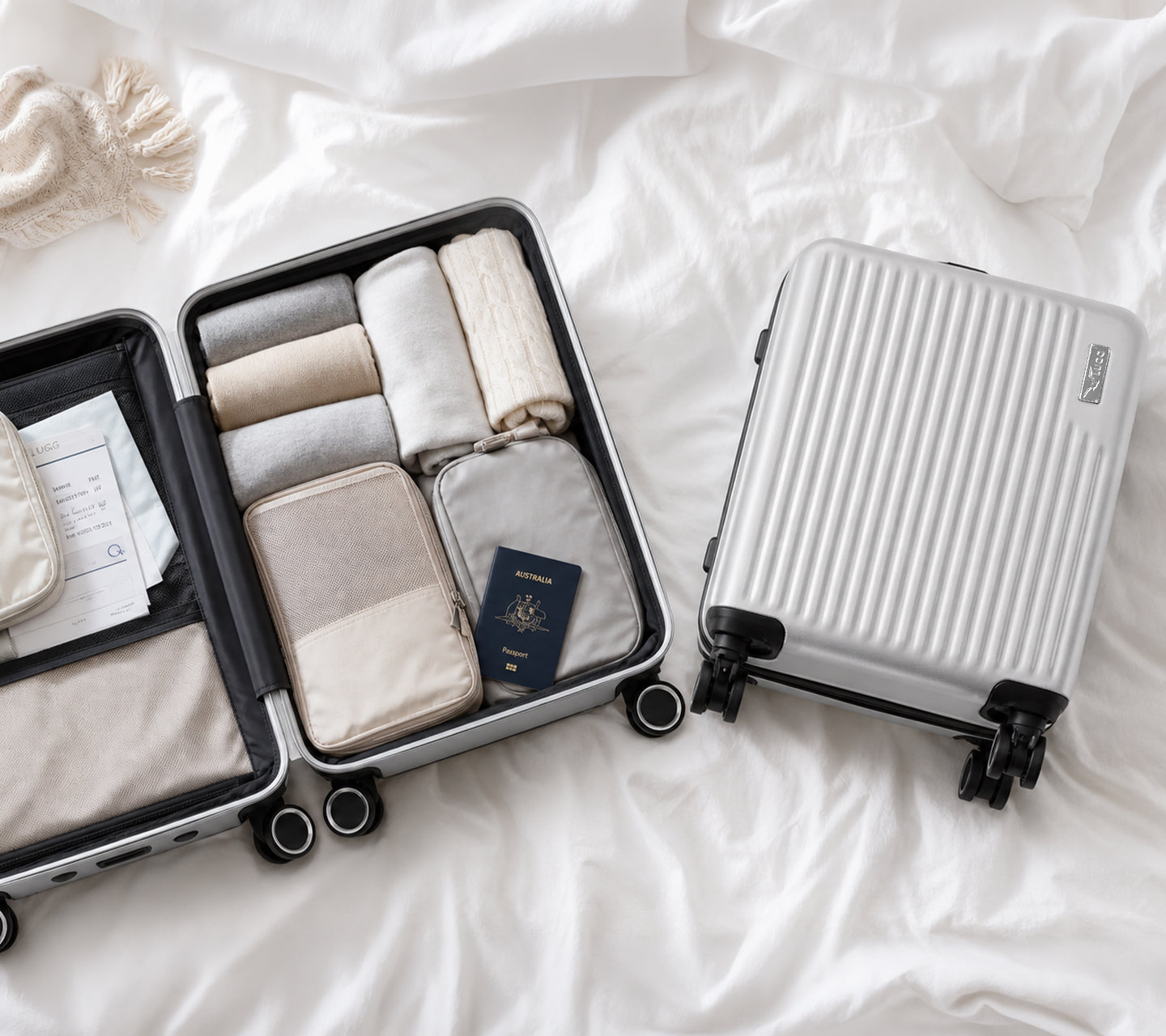
- Use packing cubes: They compress clothing and keep your liquids bag accessible at the top for security.
If you’re right at the limit, make sure your personal item is genuinely carrying its weight too. A structured tote or laptop bag can hold far more than most people use them for. Also think about getting a portable luggage scale to check on your baggage on the go. For a full list of things that catch travellers out at the airport, read our guide to common packing mistakes to avoid.
FAQs About Cabin Baggage Rules
What size bag can I take in the cabin?
The accepted maximum is 55 x 40 x 20 cm, including wheels and handles. Some airlines allow slightly larger bags; budget carriers may require smaller ones depending on your fare. Always check your specific airline’s current policy so that you don’t have to pay a hefty fine.
How many bags am I allowed in the cabin?
Typically, one main cabin bag and one smaller personal item. Some budget airlines only include the personal item in cheaper fares, with the overhead locker bag charged as an extra.
Do I have to take my liquids out at security?
On most routes in Europe, yes. Liquids must be in containers of 100 ml or less, placed in one transparent resealable bag. Some airports have CT scanners that allow liquids to stay in your bag, but this isn’t yet standard everywhere, so get ready for everyone to see what brand of toothpaste you use.
Can I take food through airport security?
Solid food is permitted. Liquids and pastes (soups, jams, yoghurts) must comply with the 100 ml rule. Food purchased after security in the departure lounge is not subject to restrictions - but it might leave you short on cash!
What happens if my bag is too big at the gate?
It will usually be checked into the hold and you’ll be charged a fee. On budget carriers this fee is often significantly higher than if you’d paid in advance. If it’s a close call, most airlines have a bag sizer (usually a big metal gauger) at the gate you can test your bag in before boarding.
Are there weight limits for cabin bags?
Many airlines don’t formally enforce a weight limit for cabin bags, but those that do typically apply limits between 7 and 10 kg. Be warned: budget carriers are more likely to check. If you’re uncertain, treat the stated limit as final.
Can I bring a power bank in my cabin bag?
Yes, most personal power banks are permitted in the cabin. For security reasons, they can’t travel in the hold. Power banks over 160 Wh are generally prohibited entirely. Check your specific airline’s policy if you’re unsure of your device’s capacity.
Do cabin baggage rules differ by airline?
Yes. While most airlines use similar size limits, fees, weight limits and personal item policies vary significantly. Budget carriers like Wizz Air, Ryanair and easyJet tend to have stricter or more tiered policies than full-service airlines.

Leave a comment
This site is protected by hCaptcha and the hCaptcha Privacy Policy and Terms of Service apply.